If you need a real truck but you’d rather not spend the next six years making monthly payments that rival a mortgage, you’re in the right place. The used truck market has finally cooled off enough that sharp buyers can land a genuinely capable, genuinely reliable pickup for under $30,000—if they know which years and models to target.
That’s exactly what this guide does. Every truck on this list was selected from our Reliability Index, which ranks pickup trucks by repair severity and repair frequency. The mileage noted for each entry is the approximate threshold at which current market prices fall to or below that $30,000 ceiling. This isn’t a list of the cheapest trucks available—it’s a list of the best trucks you can actually afford.
The bottom line up front: if you want a used truck under $30k that you can depend on, you’re mostly shopping Toyota, Nissan, and—for a couple of smart picks—GM. Here’s what the data says.
The Full List: Best Used Trucks Under $30,000
2016 Toyota Tundra — ~100,000 Miles
Segment + Year Rank: 2 out of 9 · Frequency Index: 0.25 · Severity Index: 0.85
The Tundra rarely gets the attention it deserves in the full-size segment because it’s not the best-seller—but that’s exactly why it’s such a good deal used. Toyota’s full-size pickup has one of the most proven drivetrains in the segment, with the 5.7L V8 engine widely regarded as one of the most durable truck motors ever built. At around 100,000 miles, you’re looking at a truck that’s barely broken in by Tundra standards.
Those index numbers tell the story: a Frequency Index of 0.25 means it breaks down at roughly a quarter the rate of the average vehicle, and a Severity Index of 0.85 means that when something does need attention, it lands below average in cost and seriousness. That combination puts the 2016 Tundra firmly in the bottom-left quadrant of the reliability matrix—exactly where you want to be.
The 2016 model predates the full redesign, so parts availability is excellent and independent mechanics are deeply familiar with it. Don’t be intimidated by the mileage—this engine regularly goes to 300,000+ miles with basic maintenance.
What to look for: Frame rust is the primary concern on older Tundras in northern states. Request a full frame inspection before purchase. Timing chain noise at cold start can indicate deferred maintenance. Otherwise, this is one of the most straightforward used truck purchases available.
Who it’s for: Buyers who need real full-size towing capacity (up to 10,500 lbs with the 5.7L) and want maximum long-term reliability without the full-size price tag.
2017 Toyota Tundra — ~110,000 Miles
Segment + Year Rank: 1 out of 10 · Frequency Index: 0.26 · Severity Index: 0.89
Everything said about the 2016 applies here—with the added benefit of being one model year newer and featuring a few minor refinements Toyota made to the interior and infotainment. At 110,000 miles the pricing drops into that sub-$30k sweet spot, making it arguably the best value on this list for buyers who need a full-size truck.
The 2017 Tundra earns the top rank in its segment and year—#1 out of 10—with a Frequency Index of 0.26 and a Severity Index of 0.89. It breaks down rarely, and when it does the repair is below average in seriousness. That’s the profile of a truck you can buy with confidence and largely forget about.
The 2017 also benefits from Toyota’s legendary resale value curve working in the buyer’s favor—the truck has already taken its steepest depreciation hit. From here, it holds value exceptionally well, which matters if you ever need to sell or trade it.
What to look for: Same frame inspection advice as the 2016. Check service records for timing chain maintenance and differential fluid changes. A truck with documented oil changes is worth a small premium.
2017 Toyota Tacoma — ~100,000 Miles
Segment + Year Rank: 3 out of 10 · Frequency Index: 0.42 · Severity Index: 0.97
The Tacoma is the undisputed king of mid-size truck reliability. It has held the top spot in reliability surveys for over a decade, and the 2017 model represents the second generation of the current design—a generation that, as of this writing, has proven itself extraordinarily durable across hundreds of thousands of owner miles.
The Frequency Index of 0.42 is slightly higher than the Tundra’s—meaning it visits a shop a bit more often—but the Severity Index of 0.97 keeps it right at the average for repair seriousness, and both figures are well below what you’d see from a comparable F-150 or Ram. For a mid-size truck with a vehicle population of nearly 200,000, those numbers hold up remarkably well.
For buyers who don’t need a full-size truck—and many who think they do, actually don’t—the Tacoma makes an exceptionally compelling case. Better fuel economy, easier parking, still capable of towing 6,800 lbs and hauling gear in the bed.
The mid-size used market has been aggressive on Tacoma pricing precisely because demand is so high. Expect to work harder to find one under $30k at 100k miles than you would with a comparable Tundra. When you find one, move quickly.
What to look for: The 2017 Tacoma had a known issue with rough transmission behavior, particularly the automatic hesitating between 1st and 2nd gear in light throttle situations. Toyota issued a software fix; confirm it’s been applied. Also check for frame rust in high-salt states.
Who it’s for: The buyer who wants a truck that will still be running reliably in 10 years. Overlanders, tradespeople who need bed space but not maximum payload, and anyone who just wants something they never have to worry about.
2020 Toyota Tacoma — ~100,000 Miles
Segment + Year Rank: 2 out of 13 · Frequency Index: 0.18 · Severity Index: 1.06
The newer generation Tacoma benefits from updates to the V6 engine, a revised suspension, and a meaningfully improved cabin compared to earlier model years. By 2020, Toyota had also addressed most of the transmission grumbling from the 2016–2018 era through calibration updates.
The 2020 posts the lowest Frequency Index on this entire list at 0.18—it goes to the shop less than any other truck here. The Severity Index ticks up slightly to 1.06, which puts it just above the class average when something does need attention. That’s a reasonable trade-off for a truck ranked #2 in a field of 13, competing against a much larger vehicle population than the Tundra.
At 100,000 miles, a 2020 Tacoma is still a relatively young truck. Properly maintained, it has at minimum another 150,000 miles ahead of it. Finding one under $30k will take some patience—Tacoma values have held up better than almost any other vehicle in its class—but it’s achievable, particularly in markets with higher supply.
Smart buying tip: Search a wider geographic radius than you normally would. Tacoma pricing varies significantly by region. Trucks in the Southeast and Midwest often carry lower prices than identical units on the coasts.
2021 GMC Canyon — ~65,000 Miles
Segment + Year Rank: 2 out of 13 · Frequency Index: 0.22 · Severity Index: 0.81
The Canyon earns its spot on this list not because it competes with the Tacoma on reliability—it doesn’t, quite—but because at 65,000 miles it represents a genuinely capable, refined mid-size truck with a lot of useful life remaining, at a price that’s hard to argue with.
The numbers are actually better than its reputation suggests. A Frequency Index of 0.22 and a Severity Index of 0.81 place it firmly in the bottom-left quadrant of the reliability matrix—low frequency, low severity. That Severity Index of 0.81 is, notably, lower than either the 2017 or 2020 Tacoma, meaning when a Canyon does need a repair, it tends to be less serious than what a Tacoma owner faces. That’s not something you’d expect, and it earns the Canyon more credit than it usually gets.
The 2021 Canyon was the final year of that generation before a full redesign, meaning it’s a well-sorted, mature product. GM had worked out most of the early gremlins. The interior quality is noticeably higher than the Tacoma or Frontier, which matters for buyers who spend significant time in their cab.
The Canyon pairs well with buyers who want a daily driver that pulls double duty as a capable weekend hauler, without the bulk of a full-size. The available Duramax diesel option—if you can find one in this price range—offers exceptional fuel economy for a truck.
What to watch: The Canyon’s repair costs are higher than Toyota alternatives when things do go wrong. At 65k miles, you’re likely beyond the covered powertrain window on most used car warranties, so verify whether any CPO coverage remains. An independent pre-purchase inspection is worth every penny here.
2021 Nissan Frontier — ~60,000 Miles
Segment + Year Rank: 3 out of 13 · Frequency Index: 0.19 · Severity Index: 0.90
Here’s an underrated pick that deserves more attention than it gets. The 2021 Frontier was the last year of Nissan’s previous generation—which, despite being long in the tooth by 2021, was a proven, dependable, and frankly underestimated truck. Nissan had refined it over so many years that the major issues had been sorted out long ago.
The index numbers back that up. A Frequency Index of 0.19 is among the lowest on this list—this truck rarely needs unscheduled attention. The Severity Index of 0.90 keeps repairs well below the class average in seriousness. Third out of 13 trucks in its segment and year is not where most people expect to find a Frontier, but the data doesn’t lie.
The 3.8L V6 engine, producing 310 horsepower, is genuinely strong for a mid-size truck. Towing capacity reaches 6,720 lbs. And because the Frontier doesn’t carry the Tacoma’s cult following, you can frequently find comparable trucks for several thousand dollars less.
The value case: If your priority is maximum truck for minimum dollar—and reliability that won’t embarrass itself next to a Tacoma—the 2021 Frontier deserves serious consideration. It’s the best value play on this list.
2019 Nissan Frontier — ~60,000 Miles
Segment + Year Rank: 1 out of 12 · Frequency Index: 0.20 · Severity Index: 0.83
The 2019 Frontier carries essentially the same story as the 2021—a mature, proven platform that punches above its price point in reliability. At similar mileage, you may find the 2019 priced $1,500–$3,000 lower than the 2021, which can matter if you’re working with a strict budget.
What makes the 2019 stand out on paper is its rank: #1 out of 12 in its segment and year. That’s not a typo. With a Frequency Index of 0.20 and a Severity Index of 0.83, the 2019 Frontier topped its entire competitive class. The main difference between the 2019 and 2021 is a minor powertrain update Nissan made in 2020, and some interior improvements. For most buyers—especially those who are going to use the truck hard—the 2019 represents a smart, unpretentious purchase.
What to look for: Check the timing chain for noise. Also inspect the radiator, as some 2019 models have shown early cooling system wear. Otherwise the Frontier is straightforward—parts are cheap, mechanics know it, and it runs.
Go Deeper: The Full Interactive Reliability Dashboard
The trucks on this list represent the best options at the $30,000 ceiling right now—but your situation might be different. Maybe you need a specific tow rating, or you’re open to a different price point, or you want to compare how a 2018 Tundra stacks up against a 2019 F-150 before you commit. A curated list only goes so far.
For that kind of granular, side-by-side research, the full Reliability Index is available at vehiclereliability.com. The interactive dashboard covers every major pickup truck make and model going back 20 years, with filters by year, mileage range, reliability score, and average annual repair cost. You can pull up any combination—say, every mid-size truck from 2015 to 2022—and see exactly where each one falls on the reliability matrix that shapes the recommendations in this article. If you’re serious about buying right, it’s worth 20 minutes before you set foot on a lot.
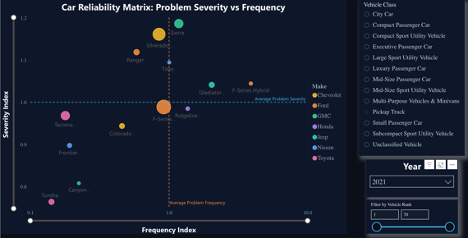
- Bottom Left — Low frequency, low severity. Rarely breaks. When it does, it’s minor. The most reliable vehicles in the class for that year.
- Top Left — Low frequency, high severity. Rarely breaks, but when it does, expect something serious — transmission, engine, drivetrain.
- Bottom Right — High frequency, low severity. In the shop often, but the problems are manageable and cheap.
- Top Right — High frequency, high severity. The worst of both worlds. These vehicles break the most and cost the most to fix.
Explore the full dashboard at vehiclereliability.com—filter by make, model year, and mileage to find the best truck for your specific situation.
The Bottom Line
There’s a temptation when buying a used truck to chase the newest model or the lowest mileage you can find within a budget. Resist it. The trucks on this list were chosen because the data supports them—not because they’re the flashiest options or the easiest sells on a dealer lot.
If you can afford to be patient, the 2017 or 2020 Tacoma is the best all-around choice for someone who wants a truck that will still be running reliably in a decade. If you need full-size capability, the 2017 Tundra at 110,000 miles is an exceptional value that most buyers overlook simply because of the mileage number.
And if you’re working with a genuinely tight budget and want maximum truck per dollar, the 2019 Nissan Frontier is the answer the market consistently underprices. Take it seriously.
Whatever you buy: get the inspection, check the frame, and don’t skip the service history. The $30,000 you’re spending deserves that diligence.